



Performers
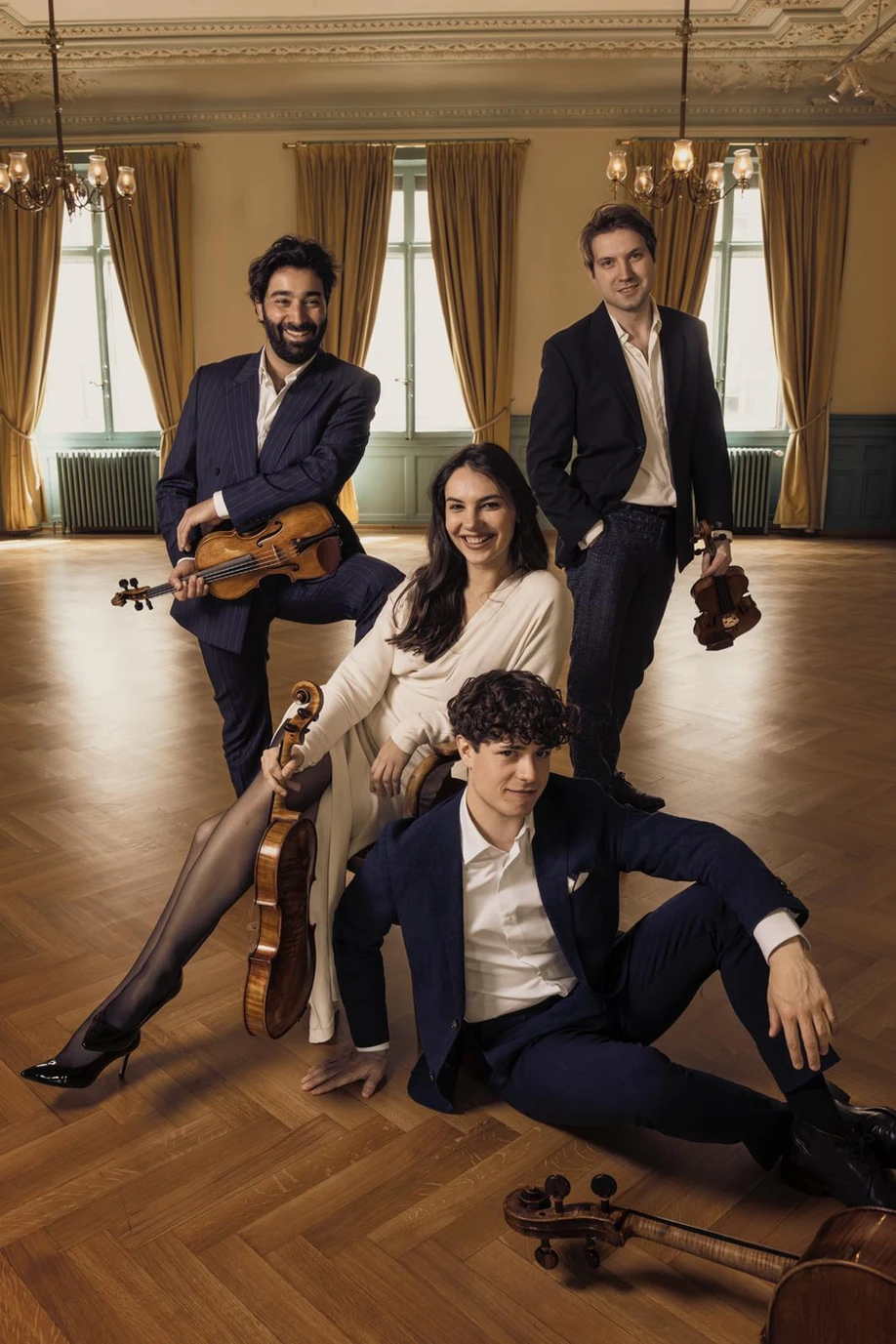
- Quatuor Elmire
- David Petrlik I violin
- Yoan Brakha II violin
- Hortense Fourrier viola
- Rémi Carlon cello
Programme
Joseph Haydn String Quartet in D major, Op. 76 No. 5, Hob.III:79 [18’]
I. Allegretto – Allegro
II. Largo. Cantabile e mesto
III. Menuetto: Allegro – Trio
IV. Finale: Presto
Ludwig van Beethoven String Quartet No. 8 in E minor, Op. 59 No. 2 [37’]
I. Allegro
II. Molto adagio. Si tratta questo pezzo con molto di sentimento
III. Allegretto – Maggiore (Thème russe)
IV. Finale: Presto
Concert description
Palaces, salons, theaters, churches, cafes, and squares… At the turn of the 18th and 19th centuries, Vienna’s musical life knew no boundaries. One of the most prestigious and, at the same time, most intimate (which is not contradictory at all!) genres was the string quartet. Joseph Haydn and Ludwig van Beethoven are celebrated as its greatest masters and innovators. The former composed over eighty quartets, the latter – sixteen, but much more elaborate ones. Those selected by Elmire – Haydn’s D major, Op. 76, No. 5 and Beethoven’s E minor, Op. 59, No. 2 – are among the most famous.
The oldest of the Viennese classics dedicated Op. 76 to Hungarian Count Joseph Georg von Erdődy. The fifth of the six quartets in this collection is sometimes referred to as the “Graveyard Quartet” because of the exceptionally extended slow second movement Largo. Cantabile e mesto. Its melancholy, however, is matched by serenity and tranquility, and the somewhat heavy minuet that follows and the breakneck rushing Presto dispel any remaining reverie.
Opus number 59, in turn, hides a group of three compositions better known as the “Razumovsky Quartets.” They were commissioned from Beethoven by the Russian ambassador to Vienna, Prince Andrey Razumovsky. As a tribute to the patron, they incorporated Russian folk melodies. However, some musicologists suspect that the specific, mocking elaboration of one of them in the third movement of the Quartet in E minor indicates that the composer did so reluctantly. Here, too, as in Haydn’s quartet, attention is drawn to the second, slow movement, bearing the instruction to play it “with great affection.”
– Dominika Micał (pisanezesluchu.pl)